
Your listing was there yesterday. This morning a homeowner searched foundation repair near me and you are not in the map results at all. Inside your Google Business Profile dashboard there is a banner saying the profile is suspended, with a policy link that explains nothing about your specific case.
If the phone has gone quiet, that is why.
This guide is for foundation repair, basement waterproofing and crawl-space companies, because service-area businesses get suspended at a higher rate than businesses with a storefront, for reasons that are structural rather than bad luck. It covers what to do first, the four causes that account for most contractor suspensions, and how to appeal without wasting the review you get.
One caution before anything else. Google’s policies and tooling change, sometimes without announcement. Everything here reflects the rules as published in September 2026, and the two links that matter are Google’s own page on fixing suspended profiles and the Business Profile guidelines. Check both before you act, because a guide written a year ago will confidently tell you to do things that no longer apply.
Why this hits foundation contractors harder
Most foundation and waterproofing companies are what Google calls a service-area business. You go to the customer. Nobody drives to your unit to buy a pier.
That category carries rules that storefront businesses never have to think about, and every one of them is easy to trip:
- Your address must be hidden if customers are not served there. A visible home address is a violation, not a preference.
- Your service area has to be a plausible driving distance, not the whole state because you would take a job anywhere.
- You have no shopfront signage, so when Google asks you to prove the business is real, the easy evidence a retailer would use does not exist.
Add the trade’s competitive naming habit, where half the market calls itself something like City Foundation Repair Specialists, and you have a category primed for automated enforcement.
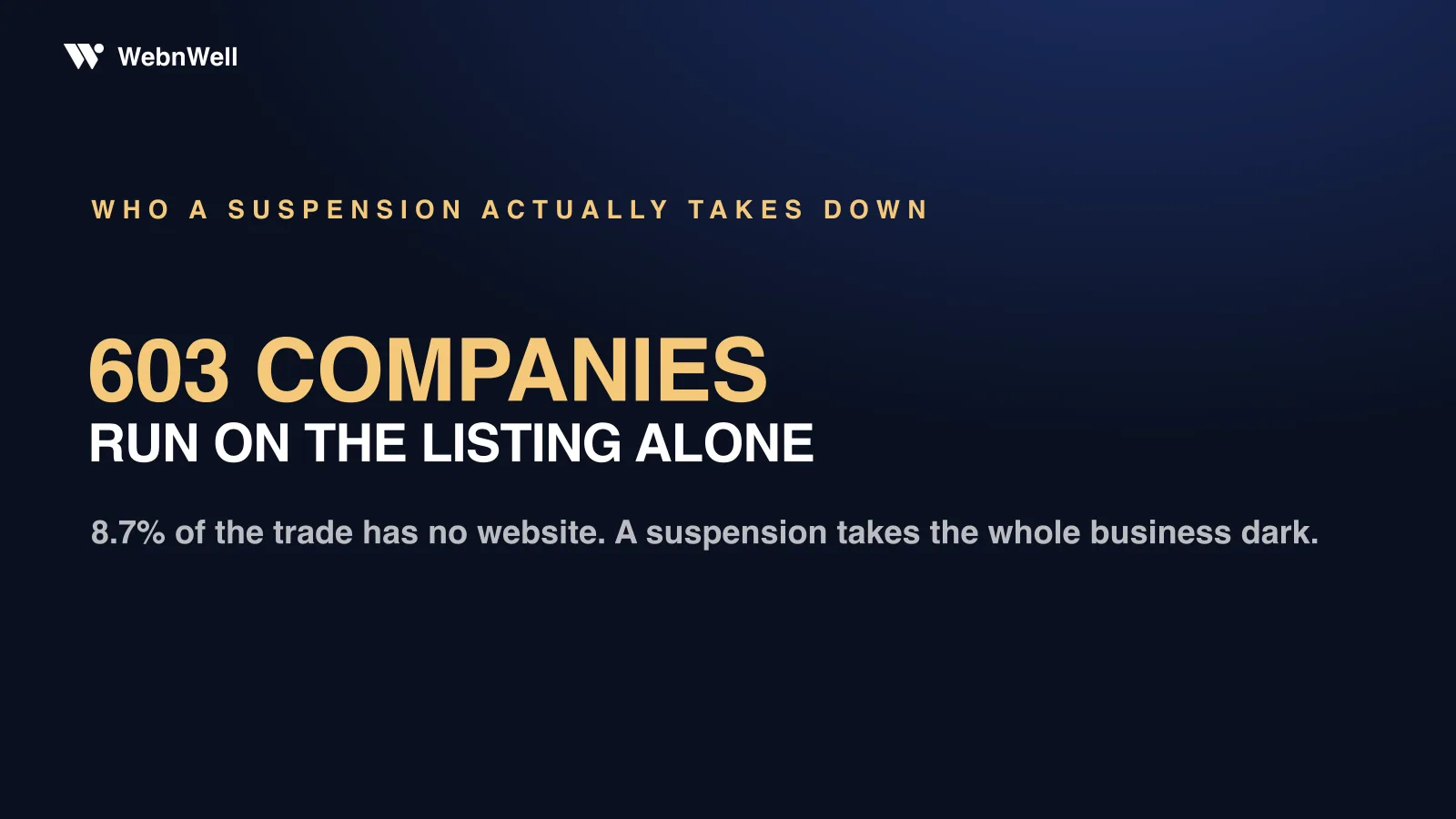
And the stakes are not evenly distributed. In our audit of the trade, 603 companies, 8.7% of the whole market, have no website at all. They run on the Google listing alone. For those owners a suspension is not a marketing setback. It is the entire business going dark.
The first hour: stop editing
The instinct is to start fixing things. Resist it.
Rapid edits to a suspended profile can look to Google’s systems exactly like the behaviour that triggers enforcement in the first place, and you may destroy the evidence of what your profile said when it was suspended.
Do this instead, in this order:
- Screenshot everything. The business name exactly as written, the address field and whether it was hidden, your categories, your hours, your service area, your website URL and your phone number. You will need to show what the profile looked like, and you may need to prove a field was already correct.
- Read the suspension notice properly. It names a policy. That is your starting hypothesis, and it is more specific than it first appears.
- Find the actual violation before you touch anything. An appeal that fixes the wrong thing gets denied, and denials are expensive for a reason we will come to.
- Check whether you can still see the profile. If it is gone from Maps entirely, that is a harder case than a profile still listed but no longer verified. The distinction changes what you are arguing.
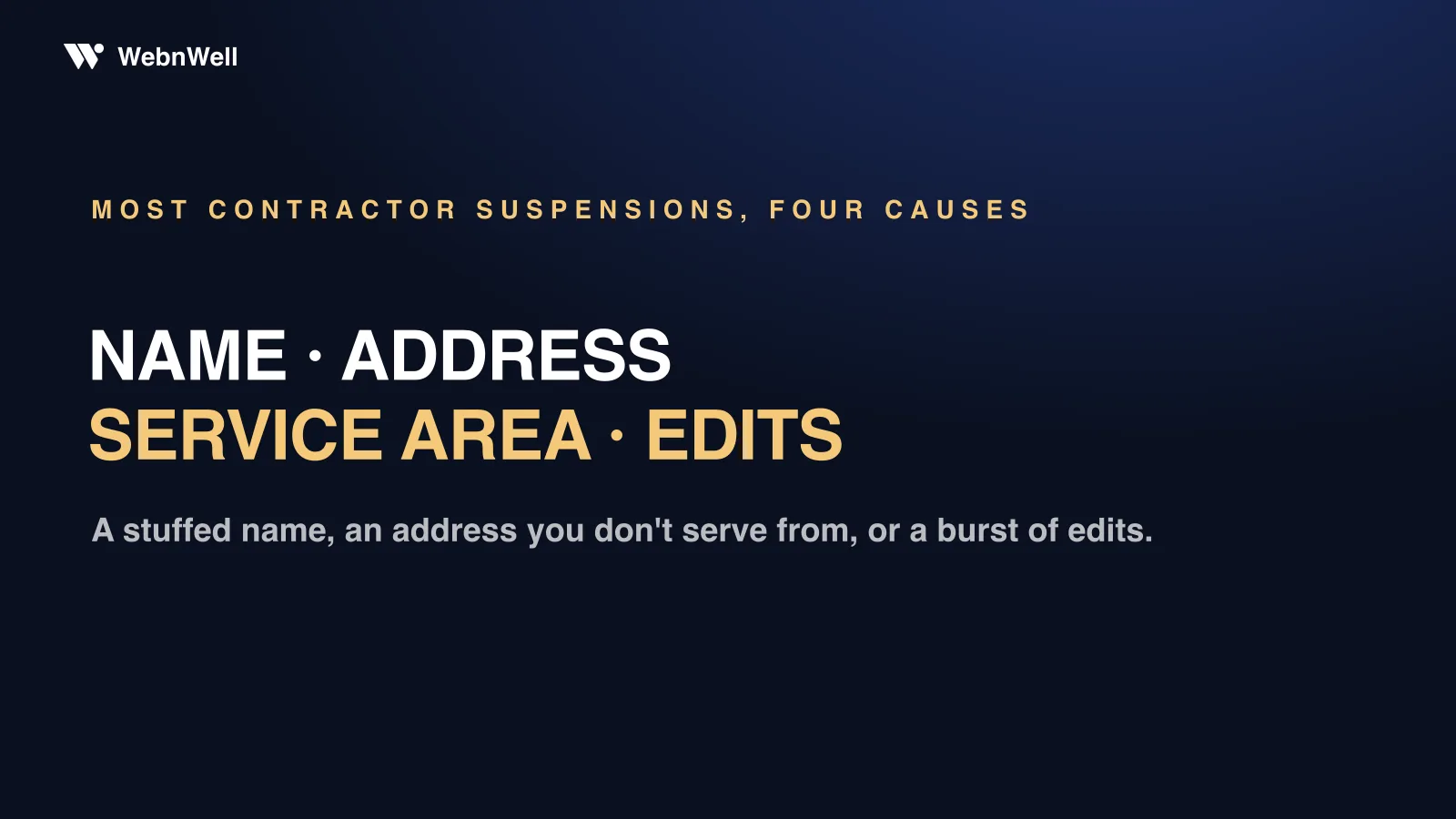
The four causes that account for most contractor suspensions
1. A keyword-stuffed business name
This is the leading cause, and it is the one contractors argue about most.
Google’s rule is that your name must be your real-world business name — the one on your signage, your registration, your invoices and your truck. Not the name plus the service. Not the name plus the city.
Garcia Foundation Repair is a business name. Garcia Foundation Repair, Basement Waterproofing Denver is a name plus a keyword list, and the fact that competitors do it and get away with it is not a defence. Enforcement in this area is inconsistent and retroactive: a name that survived for three years can be actioned the week a competitor reports it.
The keywords belong in the fields built for them: your description, your services list, your posts and your review replies, where they are allowed and where they do some good.
2. A visible address you do not serve customers at
If you work out of your home, or out of a yard where no customer ever arrives, the address must be hidden and only the service area shown. A residential address displayed publicly is a straightforward violation.
The related trap is using a mailbox service or a virtual office to look more established. Google’s verification is unusually good at recognising those, partly because thousands of businesses share the same handful of addresses. A registered-agent address or a mail drop is not a location for these purposes.
3. A service area that is not credible
Setting your service area to an entire state, or to a radius you could not physically drive in a day, invites scrutiny. The working guidance is a real driving distance from where you operate. A two-hour radius is the commonly cited ceiling, and for most contractors the honest answer is considerably smaller.
Overreaching here rarely wins work anyway. It dilutes your relevance in the market where you actually compete.
4. A burst of edits, or a mismatch with your other records
Changing several core fields at once (name, address, category, phone) is a pattern that triggers automated review, particularly on a profile that has recently changed hands or been reclaimed.
So does inconsistency. If your business registration, your website footer, your invoices and your profile disagree about your legal name or address, an assessor comparing them has a reason to doubt the profile rather than the paperwork.
How to appeal without wasting it
Here is the part worth being precise about, because a lot of advice online gets it wrong.
You submit one appeal through Google’s Business Profile appeals tool. If it is denied, Google says it may be able to carry out an additional review. That is not a guaranteed second attempt, and it is not an appeals process with defined rounds. Treat your first submission as the one that has to work.
That single fact should change how you prepare.
Fix the violation before you appeal, not after. An appeal is a claim that the profile now complies. If the name is still stuffed when you submit, you are asking Google to approve something that still breaks the rule.
Gather evidence that ties the business to the name and address you are claiming. Google asks for things like official business registration, a business licence, tax certificates and utility bills in the business name. For a contractor, the strongest supporting evidence usually includes your state contractor licence, your insurance certificate, and photographs of vehicle signage with the business name visible.
Make the documents agree with the profile. This is where most appeals quietly fail. If your licence says Garcia Foundation Repair LLC and the profile says Garcia Foundation & Waterproofing, you have handed the reviewer a reason to deny.
Write plainly. State what the violation was, what you changed, and what the attached evidence proves. A reviewer moving through a queue needs to see compliance quickly. Arguing that competitors do the same thing does not help you.
Then wait. Google’s published guidance suggests a few business days. In practice through 2026, a clean case has been taking longer than that, and appeals submitted during an enforcement wave can take several weeks. Submitting again because you have heard nothing does not speed it up.
What to do while you are suspended
The listing may be gone, but the demand has not disappeared. Homeowners with water in the basement are still searching today.
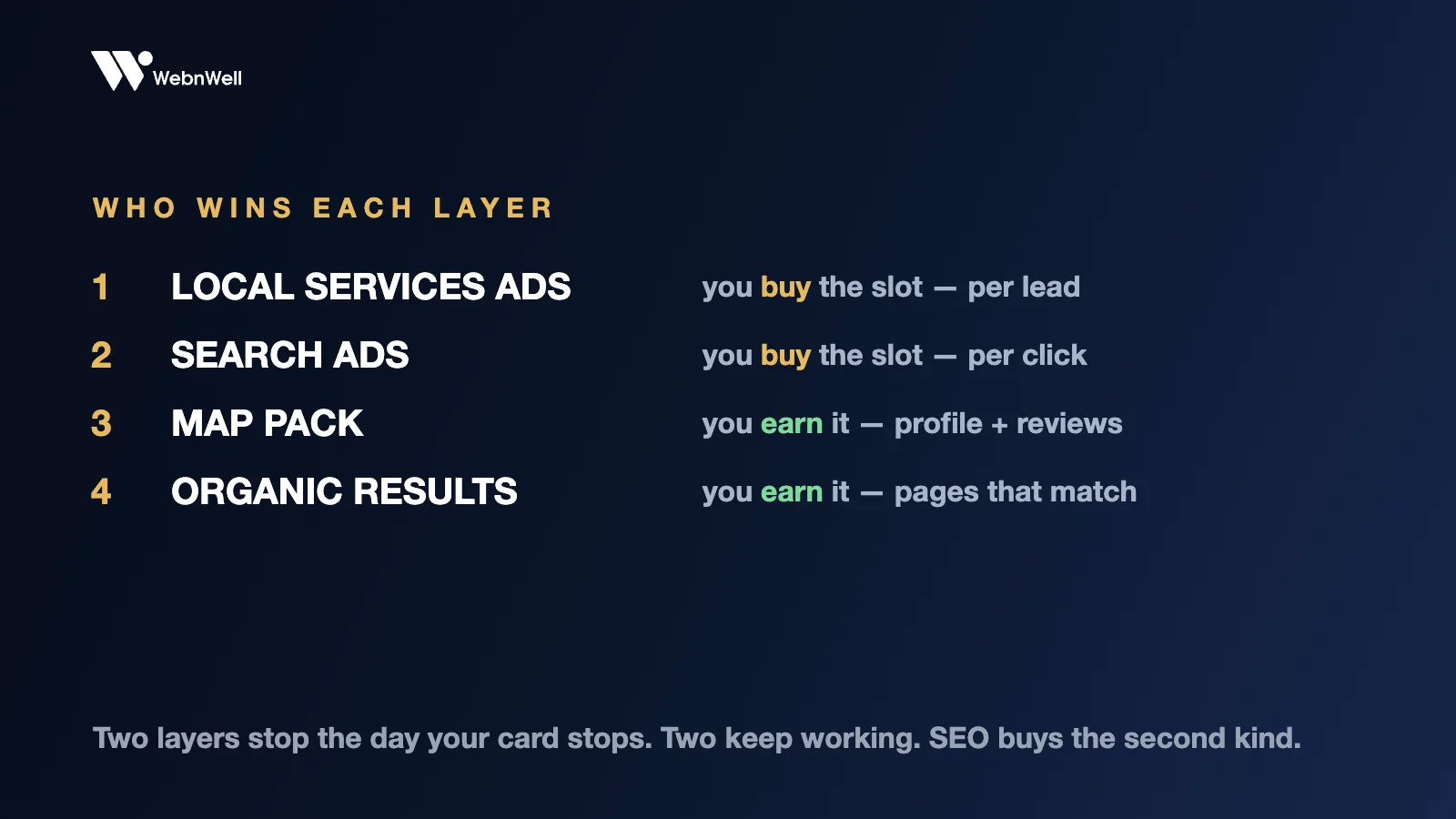
- Search ads still run. They are independent of your Business Profile, and this is the one lever that restores inbound calls within hours rather than weeks. If you have never run them, this is a difficult week to learn, but it is also the only fast option.
- Your website is doing all the work now, which is a problem if it was already weak. In the same audit, 22% of live contractor sites offer no contact form or email link on the homepage and 24% load slowly enough to lose visitors. If your profile is suspended and your site cannot convert, you have no route in at all.
- Tell your existing customers. Referrals do not route through Google. This is the week to ask.
- Do not create a second profile. Creating a duplicate to route around a suspension is a violation in its own right and makes the original case considerably worse.
The check worth doing before any of this happens
Most of this is preventable in about fifteen minutes.
Open your profile and look at four things. Is the name exactly your registered business name, with nothing appended? Is the address hidden if customers are not served there? Is the service area a distance you could genuinely drive? Do your name and address match your licence, your insurance and your website footer, character for character?
If all four are clean, your suspension risk is low, and the routine enforcement waves that catch your competitors will pass you by.
We check all four as part of the free foundation marketing audit, alongside your ads and your website. You can also see where your listing stands against your local market (review count, ranking, and which competitors are advertising) with our free scorecard. No account access needed for either.
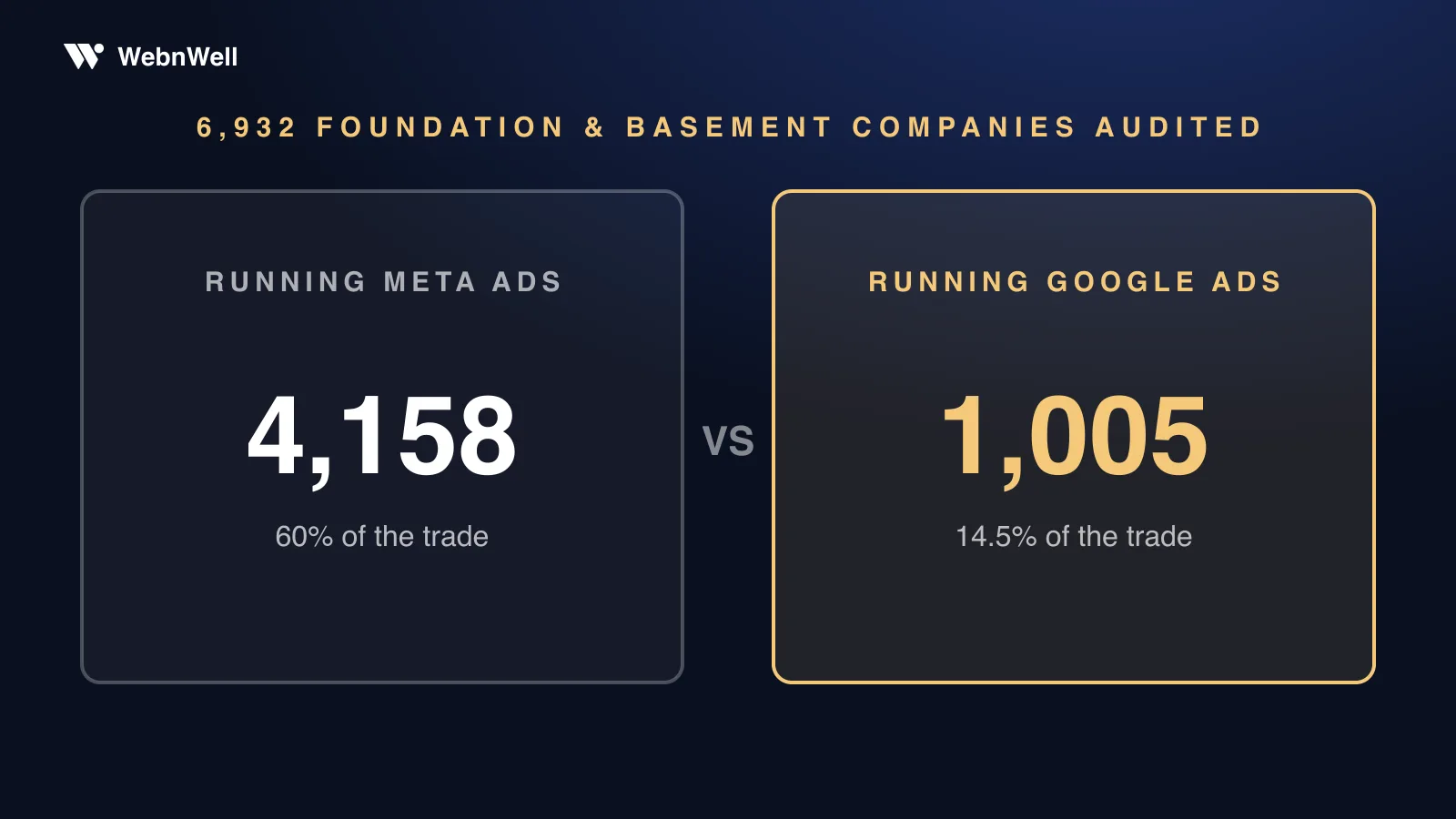
The figures in this article come from our audit of 6,932 foundation and basement companies, published as State of Foundation Repair Websites 2026.